

 Indonesian
  English
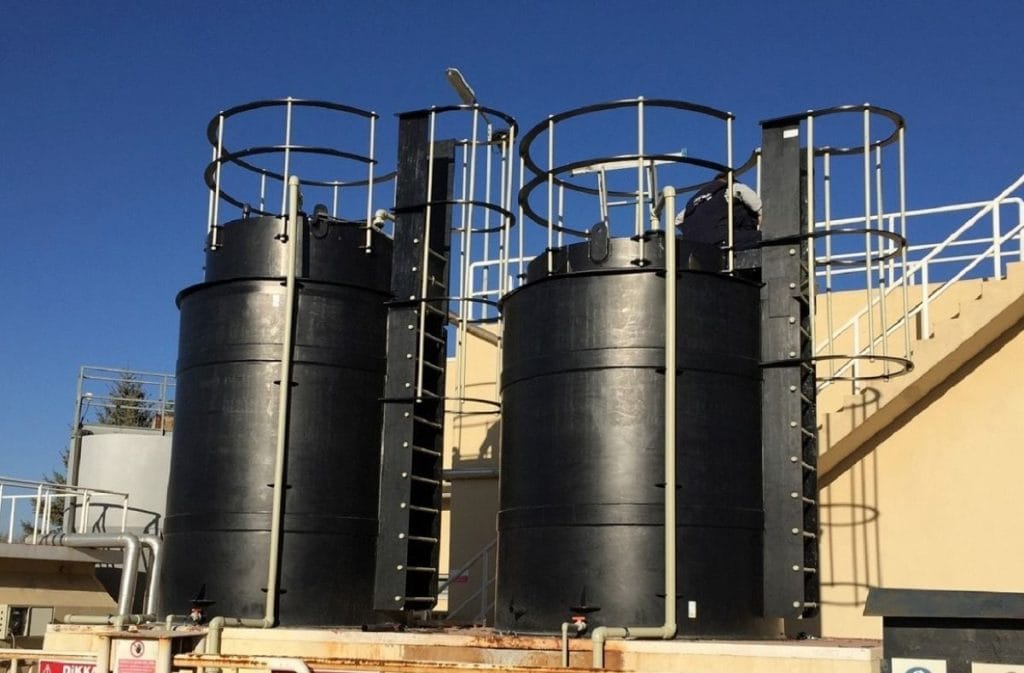
When deciding between an HDPE tank (High-Density Polyethylene) and an FRP tank (Fiber Reinforced Plastic, also known as fiberglass or GRP), many industrial users lean toward FRP for demanding applications. While both offer strong corrosion resistance and lightweight benefits, FRP often emerges as the superior choice for long-term reliability, especially in harsh chemical storage, high temperatures, and structural needs.
This guide compares the two materials fairly, highlighting why FRP tanks frequently outperform HDPE in critical scenarios.
What is an HDPE Tank?
HDPE water tanks are made from high-density polyethylene via rotational molding, creating a seamless, one-piece structure.
- Tough against impacts
- Lightweight and easy to install
- Good for many mild to moderate chemicals
- Lower upfront cost
They work well for water, wastewater, and less aggressive substances.
What is an FRP Tank?
FRP tanks combine resin (polyester, vinyl ester, or epoxy) with glass fiber reinforcement, often using filament winding or hand lay-up for customized strength.
- High mechanical rigidity and tensile strength
- Excellent for aggressive chemicals with proper resin selection
- Handles higher temperatures and pressures
- Custom shapes, sizes, and configurations possible
FRP excels in industrial and corrosive environments.
Key Comparison: HDPE vs FRP Tanks
| Feature | HDPE Tank | FRP Tank | Winner? |
|---|---|---|---|
| Corrosion Resistance | Excellent for many acids/bases | Superior with specialized resins (e.g., vinyl ester for strong acids like H₂SO₄) | FRP |
| Chemical Compatibility | Broad for oxidizers, but limited for concentrated strong acids | Wider range for harsh chemicals, hydrocarbons, solvents | FRP |
| Temperature Resistance | Typically up to 60–80°C | Up to 100–120°C+ depending on resin | FRP |
| Strength & Rigidity | Flexible, good impact but less rigid | High structural strength, handles pressure/large volumes | FRP |
| Impact Resistance | Very high (resists cracking) | Good, but can crack under extreme impact | HDPE |
| Seamless Construction | Yes (no seams) | Layered/seamed, but properly engineered seams are reliable | Tie |
| Weight | Extremely lightweight | Lightweight but slightly heavier | HDPE |
| Installation & Initial Cost | Lower cost, simpler install | Higher upfront, but customizable | HDPE (initial) |
| Long-Term Durability | 20–30+ years typical | 30–50+ years, especially outdoors/UV resistant | FRP |
| Maintenance | Minimal | Low with quality build, occasional inspections | Tie |
| Best For | Cost-sensitive, moderate chemicals, impact-prone areas | Aggressive chemicals, high temp/pressure, long-life industrial use | FRP overall |
Advantages of FRP Tanks (Why Many Experts Prefer Them)
- Superior for Harsh Chemicals — With vinyl ester or epoxy resins, FRP handles concentrated sulfuric acid, hydrochloric acid, and other aggressive substances far better than standard HDPE (which may only suit diluted versions).
- Higher Temperature Capability — Ideal for processes involving heat, where HDPE softens or deforms.
- Greater Structural Strength — Rigid design supports larger volumes, underground burial, or pressure applications without excessive deformation.
- Longer Service Life — Often lasts 30–50+ years with proper resin selection, reducing replacement frequency in demanding settings.
- Customization — Easily built in odd shapes, with compartments, baffles, or fittings for complex industrial needs.
- Better Outdoor/UV Performance — When properly formulated, FRP resists sun exposure and weathering longer in agriculture or rural installations.
- Lower Risk in Critical Applications — Proven in chemical plants, mining, and wastewater where failure costs are high.
Advantages of HDPE Tanks
- Lower initial purchase and installation costs
- Seamless construction eliminates potential leak points
- Exceptional impact and crack resistance
- Very low maintenance for non-extreme uses
Disadvantages to Consider
HDPE Tanks
- Limited heat and pressure tolerance
- May deform or fail with concentrated strong acids/solvents
- Less suitable for very large or high-load installations
FRP Tanks
- Higher upfront cost (though often offset by longevity)
- Requires quality manufacturing to avoid issues with seams or wicking
- Slightly more sensitive to severe physical impacts
Which One Should You Choose?
FRP tanks are generally the better overall choice for most industrial chemical storage, aggressive environments, high temperatures, and long-term projects. They provide unmatched durability, broader chemical compatibility, and structural reliability — making them the preferred option in chemical plants, mining, agriculture with fertilizers, and processes involving strong acids or solvents.
HDPE remains excellent for budget-conscious applications with milder chemicals, frequent impacts, or simple water/wastewater storage.
Always verify exact chemical compatibility using manufacturer charts (e.g., resin-specific data for FRP). Consult an engineer or supplier for your specific conditions — safety and performance come first.
AUTHOR BIO:

Gatot Whyd is an experienced manufacturing industry leader with a proven track record in diverse production environments. He excels in process improvement methodologies such as DMAIC, alongside strong expertise in operations management, team building, pipe manufacturing, water treatment systems, and tank fabrication. Gatot combines technical proficiency with strategic leadership to drive efficient, high-quality manufacturing solutions.